.webp&w=1920&q=82)
.webp&w=1920&q=82)
.webp&w=1920&q=82)
.webp&w=1920&q=82)
.webp&w=1920&q=82)
.webp&w=1920&q=82)
.webp&w=1920&q=82)
.webp&w=1920&q=82)
.webp&w=1920&q=82)
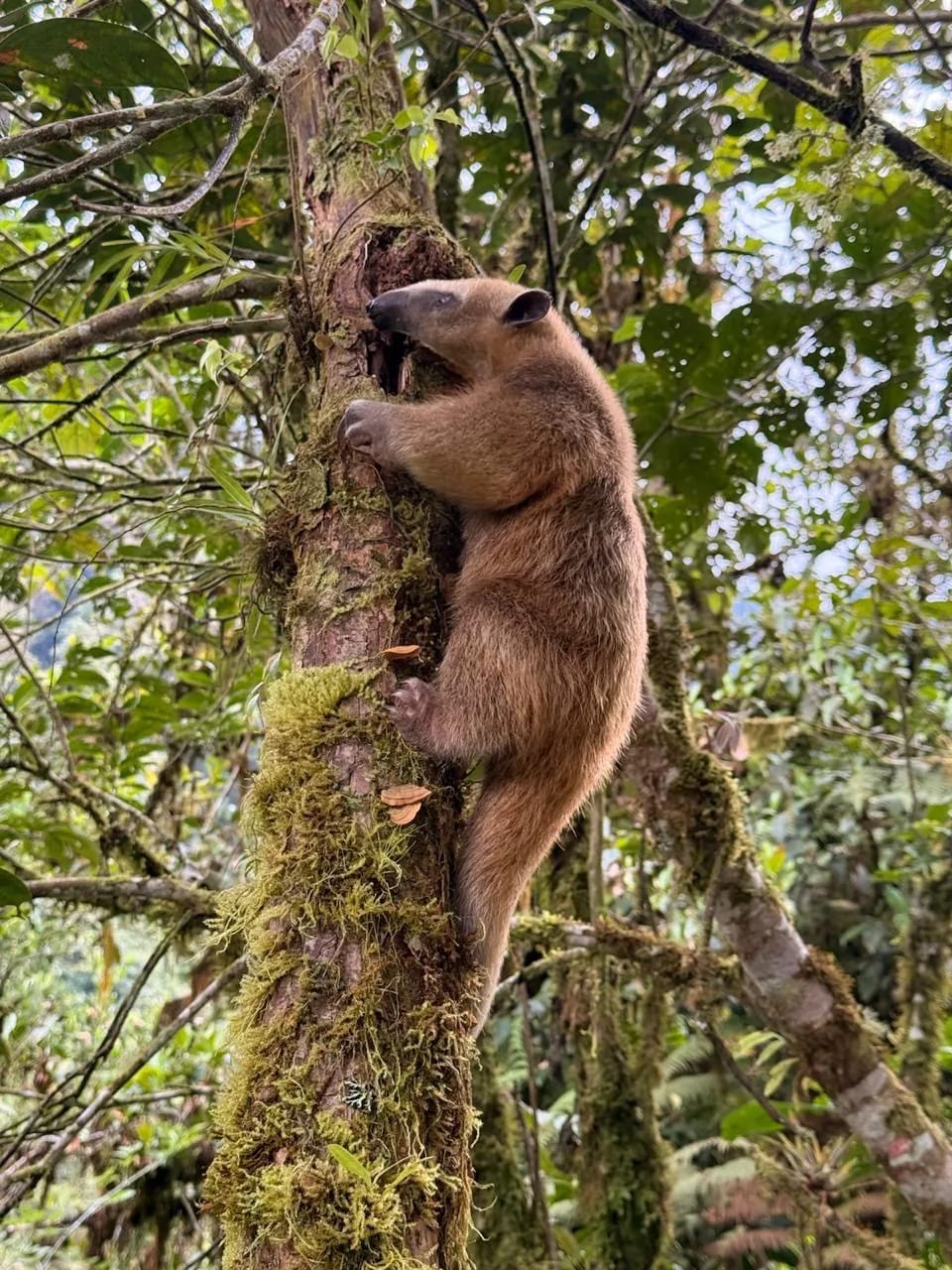
Southern tamandua
Tamandua tetradactyla
Mammals — Xenarthra (Myrmecophagidae)
The southern tamandua is a versatile xenarthran found across Brazil. Smaller than the giant anteater and more ecologically flexible, it connects forested and open habitats, playing a key role in controlling ants and termites.
Generalist insectivore of Brazil's mosaic landscapes
With semifossorial and semi-arboreal habits, the southern tamandua forages in ground termite mounds and arboreal nests. This behavioral flexibility explains its broad distribution and greater tolerance of fragmented habitats compared with other xenarthrans.
📍 Biomes it inhabits
It occurs in the Amazon, the Atlantic Forest, the Cerrado — Brazil's savanna —, the Caatinga — Brazil's dry thorn-scrub biome —, the Pantanal, and the Pampa. In Brazil, it occupies forests, savannas, riparian areas, and human-altered landscapes with remaining vegetation cover.
🌍 Conservation status (IUCN)
LC · Least ConcernAccording to the IUCN, the species is classified as LC (Least Concern). Even so, it faces local threats from roadkill, wildfires, and human persecution.
🔬 Scientific classification
- Kingdom
- Animalia
- Phylum
- Chordata
- Class
- Mammalia
- Order
- Pilosa
- Family
- Myrmecophagidae
- Genus
- Tamandua
- Species
- Tamandua tetradactyla (Linnaeus, 1758)
⚙️ Specifications and metrics
- Body mass: 3–8 kg (7–18 lb).
- Body length: 50–77 cm (20–30 in) + prehensile tail, 40–67 cm (16–26 in).
- Tongue: Long and extensible, coated in viscous saliva and specialized for capturing social insects.
- Claws: Long, curved foreclaws used to break open termite mounds and for defense.
- Tail: Prehensile, aiding arboreal movement.
- Generation length: ~6–7 years — moderate population recovery.
Diet: Specialized insectivore — ants and termites, consumed without chewing.
📅 Life cycle
- Gestation: ~130–150 days; usually 1 pup.
- Development: Young carried on the mother's back.
- Parental care: Exclusively maternal.
- Lifespan: 9–12 years in the wild.
🔗 Ecological ripple effect
The southern tamandua regulates ant and termite populations, influencing soil and vegetation dynamics. It acts as a natural biological control agent and features in food chains as occasional prey for large predators.
🤔 Why it matters
- More ecologically flexible than the giant anteater.
- Uses both the ground and trees.
- Widely distributed in Brazil.
- Tolerant of fragmented landscapes.
🧪 Did you know?
- When threatened, it can brace itself on its tail and use its claws in a defensive posture.
- Its coloration varies greatly across its range.
- The epithet tetradactyla refers to the apparent number of toes on its forefeet.
- It is often mistaken for a juvenile giant anteater.
Small discoveries
- Semifossorial and semi-arboreal
- A species that uses both the ground and tree vegetation.
- IUCN
- International Union for Conservation of Nature — the global authority on extinction-risk assessment.
- Prehensile
- Able to help support and balance the animal on branches.