.webp&w=1920&q=82)
.webp&w=1920&q=82)
.webp&w=1920&q=82)
.webp&w=1920&q=82)
.webp&w=1920&q=82)
.webp&w=1920&q=82)
.webp&w=1920&q=82)
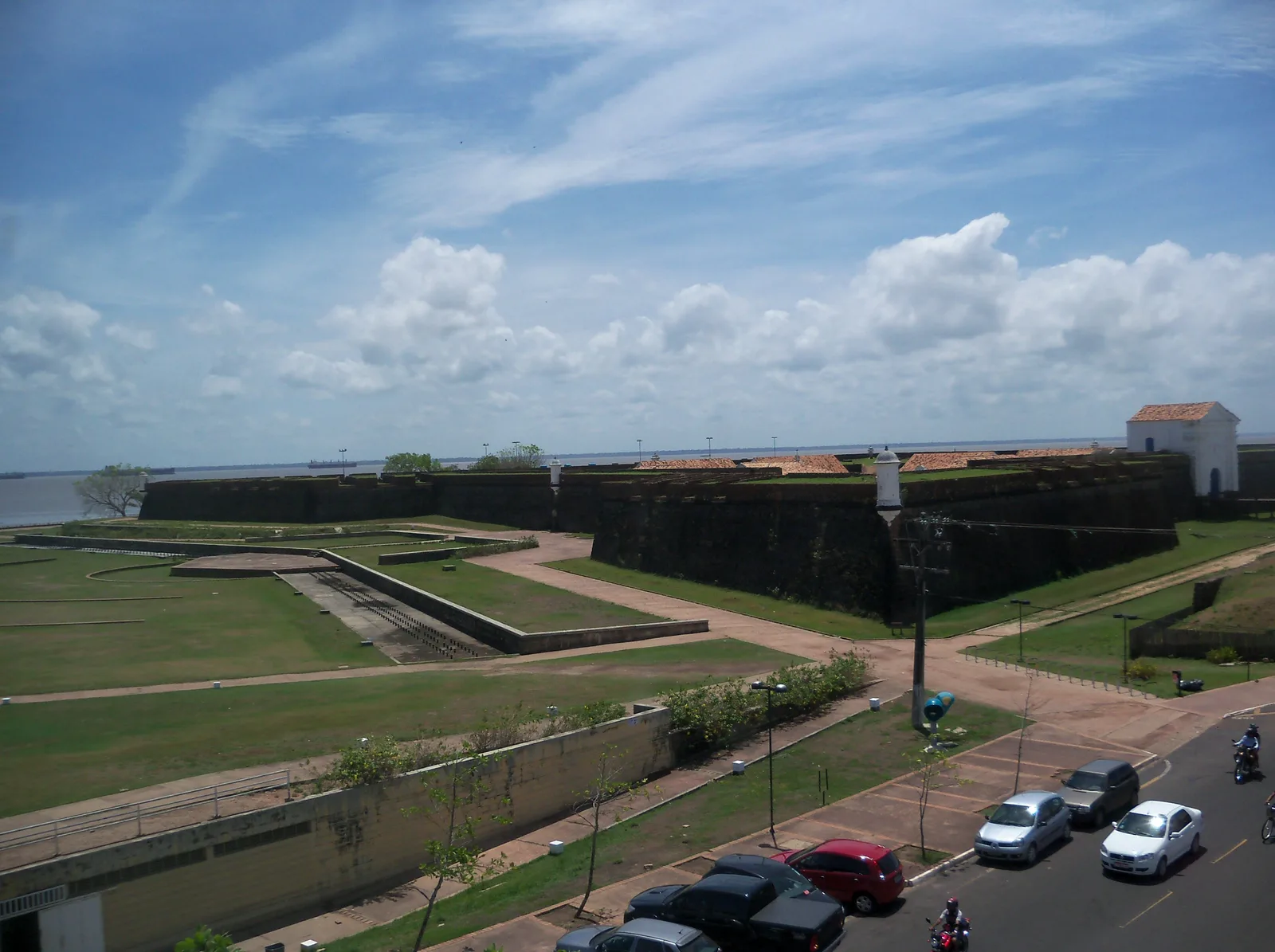
Fortaleza de São José de Macapá
Rua Cândido Mendes, downtown Macapá, on the waterfront, on the left bank of the Amazon River.
On Macapá's waterfront, a star-shaped fort sets walls, cannons and ditches against the Amazon River horizon. It is a direct encounter between equatorial landscape and colonial defensive architecture.
Within the complex, stone, earth and military geometry alter the scale of the visit: severe lines, sharply defined angles, low batteries and courtyards reveal a construction built to watch over approaches by river. Outside, muddy water, open sky and the waterfront’s side light offer a different reading of the walls. The site also houses the Museu Fortaleza de São José de Macapá.
🤔 Why does it matter?
It is an especially revealing place to understand Macapá on foot rather than simply from afar. The experience brings visitors close to a historical frontier of the Portuguese Amazon and offers one of the city’s most striking late-afternoon views.
📍 What to see
- The four bastions that form the fortification’s star layout.
- Ravelin, redan, dry ditch and low batteries, elements that explain the defensive strategy.
- Warehouses, chapel, officers’ houses, hospital, powder magazine and casemates from the fort’s former military life.
- The framing between cannons, sentry boxes and the Amazon River.
🎒 Things to do
- Walk the open perimeter and observe how the wall angles controlled the approach.
- Visit the museum exhibitions to contextualize the construction and the peoples involved in its building.
- Photograph in early morning or near sunset, when the light highlights the stone relief.
- Take advantage of a guided visit when one is scheduled.
✨ Recommended experiences
- Two-hour route: museum, interior courtyards and a circuit of the bastions at a pace suited to reading the architecture.
- Late afternoon on the waterfront: arrive early, walk through the monument and save the side light for photographs of the cannons and horizon.
- Cultural walk through downtown: combine the fortress with a stroll along the waterfront and a meal of Amapá cuisine elsewhere in the city.
🍽️ Local cuisine
🎶 Soundtrack
- Planeta Amapari — Zé Miguel, Val Milhomem and Joãozinho Gomes
- Meu Endereço — Zé Miguel
- Vida Boa — Zé Miguel
🎭 Local culture
🌿 Nature nearby
🌎 Biomes
🏞️ Natural features
🐾 Wildlife you may spot
🌱 Plants you may see
📅 Best time to visit
August to November usually offers the most comfortable window for walking outdoors, although rain is possible any month in Macapá’s equatorial climate.
- ✅ Best time:
- August to November, relatively drier months to tour exposed areas and photograph the waterfront.
- 🟡 Shoulder season:
- July and the transition toward December, with viable visits but greater dependence on clear skies.
- 🔴 Less recommended:
- December to June, when more frequent rain increases discomfort and makes stone and steps more slippery.
- 📝 Notes:
- Prioritize early morning or late afternoon; the vertical midday sun intensifies the heat and flattens the visual relief of the walls.
🧭 Getting there
🏙️ Base city: Macapá
✈️ Airport: Aeroporto Internacional de Macapá - Alberto Alcolumbre (MCP)
- From the airport, head to Macapá’s Centro by taxi, ride-hailing service or private car.
- Use Rua Cândido Mendes as a reference; the monument sits on the waterfront edge and can be reached on foot from central areas.
- For groups, confirm in advance the possibility of scheduling and the guided-visit program.
🚗 Local transportation
- Walking around the central area
- Taxi and ride-hailing cars
- Private car, observing local parking rules
ℹ️ Practical information
- 🏗️ Infrastructure:
- urban, with museum operations and restoration work underway
- 🏨 Where to stay:
- Macapá has hotels, guesthouses and services for different budgets; the attraction does not offer lodging.
- 🍴 Food:
- There are restaurants and snack options downtown and along other parts of the waterfront; food sales inside the fortress were not confirmed.
- 🧭 Guides and agencies:
- The administration reports guided-visit services; availability depends on scheduling and should be confirmed before traveling.
- 📶 Internet and signal:
- Being in a central urban area, mobile signal tends to be available, but coverage varies by operator.
- 💰 Estimated cost:
- Free entry; expenses depend mainly on transportation, food and any services contracted outside the monument.
- 📝 Notes:
- The Visite Museus platform lists opening hours from Tuesday to Sunday, 8:00 a.m. to 5:00 p.m., with free entry. Restoration work may alter entrances, internal circulation and programming.
♿ Accessibility
Level: consult local operators
No sufficient institutional information was found on continuous accessible routes, adapted restrooms, reserved parking or equipment loans. The redevelopment project provides for accessibility adaptations, but operating conditions should be confirmed before the visit.
- Inform specific needs to the administration before departing.
- Confirm which sectors are open during restoration.
- Consider that historic floors, level changes and steps can limit independent circulation.
⚠️ Safety
🚨 Real risks
- Intense heat, direct sun and high humidity.
- Stone, stairs and floors that can become slippery after rain.
- Restricted areas or routes temporarily altered by restoration work.
✅ Recommended care
- Bring water, sun protection, a hat and footwear with sturdy soles.
- Do not climb walls, cannons or closed-off structures.
- Keep normal attention to personal belongings while walking the waterfront.
⛔ When to avoid: Postpone the visit if the administration has announced closure, in cases of heavy rain with risk of slippery floors, or if health conditions make exposure to heat inadvisable.
📝 Checklist — what to bring
- Reusable water bottle
- Hat or cap
- Sunscreen
- Closed shoes or sandals with firm soles
- Light raincoat or protection for camera and phone
- ID and method of payment for expenses outside the attraction
✈️ Travel tips
- Arrive with time before sunset to explore the interior without rushing.
- First observe the fortification’s relationship with the river, then move closer to the defensive details.
- On cloudy days, enjoy the contrast of cannons and stone walls against the sky.
- Check the same day which entrance is open and whether educational or guided activities are taking place.
💡 Fun facts
- The site was chosen at about 18 meters (59 ft) above the water level, according to Amapá’s State Secretariat of Culture.
- The bastions are named Madre de Deus, São Pedro, Nossa Senhora da Conceição and São José.
- Beyond the visible structures, the complex preserves service, defense and supply spaces of the former garrison.
🤔 Did you know?
- Construction began in 1764 and the inauguration took place on March 19, 1782, after 18 years of work.
- The federal listing by IPHAN, Brazil's heritage institute, dates to March 22, 1950.
- State Law No. 1,073 of April 2, 2007, established the museum at the site.
📜 History and context
The work was conceived by the Portuguese administration to consolidate Portuguese control in the far north and deter foreign incursions into the Amazon. The project is attributed to engineer Henrique Antônio Gallúcio and follows principles of military engineering associated with Sébastien Le Prestre de Vauban. Amapá’s State Secretariat of Culture records the use of enslaved Black and Indigenous people in its construction.
🌍 Global importance
As a preserved example of 18th-century military architecture in Brazil, the fortress helps us understand the colonial contest over Amazonian frontiers on a material scale: an entire defensive system positioned strategically before the great river. Its heritage value lies in both its construction techniques and the social memories held in this territory.
🗺️ Quick map (orientation)
📌 Main base: Downtown Macapá
🧭 Landmarks
📍 Nearby places
Small discoveries
- Baluarte
- An angular projection of a fortification designed to widen the defense and field of fire.
- Revelim
- An outlying defensive work constructed in front of a fortress’s main body.
- Redente
- An angled projection in a defensive line used to control approach to the enclosure.
- Fosso seco
- A defensive excavation around or in front of walls that is not intended to remain filled with water.
- Casamata
- A protected chamber covered by a vault or heavy roof, associated with a fortification’s defense.
- Camarão no bafo
- A preparation in which shrimp are steamed, closely associated with Amapá cuisine.
- Tacacá
- A hot Amazonian broth made with tucupi, cassava starch, jambu and dried shrimp.
- Tucupi
- A yellow broth extracted from wild cassava and fermented before cooking.
- Jambu
- An Amazonian herb that produces a tingling sensation in the mouth when consumed.
- Marabaixo
- An Afro-Amapá cultural manifestation that brings together singing, percussion, dance and communal devotion.
- Batuque
- In the Amapá context, an Afro-Brazilian-rooted cultural expression marked by drums, singing and dance.